
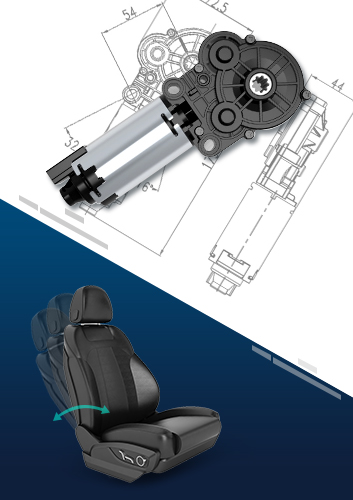
Modern automotive comfort and functionality are significantly enhanced by integrated power adjustment systems. Power seats represent a coordinated assembly where actuators manage positioning to support occupant preference and ergonomics. For a component supplier like Power Motor, the system’s core relies on the precise operation of a car seat motor or, more commonly, a network of several car seat motors. Each motor acts as a compact actuator, translating electrical energy into mechanical adjustment.
Central Actuation and Motor Configuration
The fundamental component enabling movement is the car seat motor. These are typically small, DC motors designed for high torque in confined spaces. A single power seat system integrates multiple car seat motors, each dedicated to a specific function. One motor may control fore-aft sliding, another manages seat height and tilt, and additional units can handle lumbar support adjustments and recliner functions, all working in concert.
System Integration and Control Logic
The car seat motor does not operate independently. Each is connected to a transmission system, often a gearbox or lead screw, which converts the motor’s rotary motion into linear or pivotal movement. A central control unit, usually operated by a switchpack located on the seat side, sends commands to the individual car seat motors. This networked approach allows for multi-directional adjustment from a single interface.
Performance Specifications and Durability
The design requirements for a car seat motor emphasize reliability and longevity. These motors are engineered for a high number of actuation cycles over the vehicle’s lifespan. Key performance metrics include torque output, operating noise levels, and power consumption. Suppliers like Power Motor focus on precision gearing and robust brush systems to ensure consistent performance, which is critical for user satisfaction and safety.
Power seats are a sophisticated package of electromechanical components. Their operation is dependent on the reliable function of dedicated motors for each adjustment axis, such as those supplied by Power Motor, integrated within a controlled logic system. This architecture provides the seamless positioning that defines modern automotive seating.
