
Property management teams responsible for several buildings must coordinate maintenance, inspections, repairs, and contractor access without disrupting daily operations. Choosing suitable equipment for elevated work is therefore a portfolio-wide planning decision, not simply a matter of purchasing a machine for one site. A structured approach helps managers match equipment to building layouts, maintenance schedules, safety requirements, and budgets while reducing unnecessary equipment transfers and operational delays.
Assess Building Requirements Before Selecting Equipment
The first step is to develop an inventory of each property’s maintenance needs. Office complexes, residential towers, shopping centers, and mixed-use developments can have very different access requirements. Managers should document ceiling heights, corridor widths, doorway dimensions, floor conditions, storage areas, and the locations of frequently serviced equipment.
The inventory should also distinguish routine tasks from occasional projects. Lighting inspections, detector maintenance, signage replacement, and repairs to overhead utilities may require compact access equipment, while exterior facade work or heavy construction can demand different solutions. Matching equipment to actual tasks helps prevent teams from paying for capacity they rarely use or selecting machines that cannot reach essential work areas.
Match a Vertical Mast Lift to Indoor Maintenance Tasks
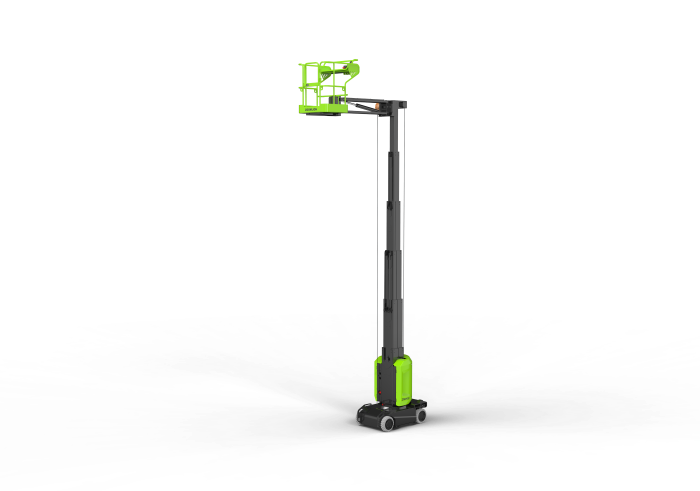
A vertical mast lift can be a practical option for indoor maintenance where technicians need to reach overhead fixtures in relatively confined spaces. Its suitability depends on the required working height, platform capacity, maneuverability, access route, and the amount of room available around the task.
Property managers should assess both the destination and the route to it. A machine that fits beneath a ceiling may still be unsuitable if it cannot pass through a doorway, turn in a corridor, or travel safely across the floor. Measurements should include thresholds, elevators, ramps, and storage entrances, rather than relying on the dimensions of the work area alone.
Platform capacity also matters. Managers need to account for the combined weight of workers, tools, and materials within the manufacturer’s stated limit. The selected machine should provide sufficient reach without encouraging technicians to overextend themselves or use the platform for tasks outside its approved operating conditions.
Plan Equipment Allocation Across the Property Portfolio
Once building requirements are documented, managers can decide whether equipment should be assigned permanently to individual sites or shared across the portfolio. A dedicated machine may be justified at a high-occupancy property with frequent maintenance requests. Buildings with intermittent needs may be better served by a shared fleet scheduled through a central maintenance team.
Scheduling should reflect task duration, travel time, contractor availability, and the consequences of postponing repairs. Grouping similar maintenance jobs by building or geographic area can reduce repeated transportation and setup. However, sharing equipment works only when schedules remain realistic and urgent repairs have a clear priority over routine work.
Property teams should also establish a booking process that records the equipment’s location, assigned operator, planned return time, and maintenance status. This creates visibility across sites and helps prevent double bookings. A central register, supported by regular coordination between facility managers, can make equipment utilization easier to evaluate.
Evaluate Zoomlion Access Specifications Against Site Needs
Product selection should follow documented site requirements rather than brand recognition alone. For example, Zoomlion Access lists the ZMP09J in its vertical mast lift range with a 11.2 m platform height and 200 kg platform capacity. Its published specifications also give a stowed drive speed of 4.5 km/h and a raised drive speed of 0.5 km/h.
These figures help property managers assess whether the model merits further evaluation for specific maintenance tasks. The stated platform height and capacity should be checked against actual access needs, including the combined weight of personnel, tools, and materials. Managers should confirm the manufacturer’s terminology when comparing platform height with working height, since these measurements are not interchangeable.
The ZMP09J’s published specifications also list a 0.99 m overall width and a 1.61 m outside turning radius. Those dimensions can inform preliminary access planning, but they do not replace physical checks of doorways, corridors, elevators, and turning areas.
When comparing vertical lift manufacturers, property managers should assess more than purchase price. Relevant considerations include technical documentation, parts availability, service coverage, operator training support, maintenance requirements, and the suitability of the equipment for the intended environment. A consistent evaluation framework makes comparisons more transparent and reduces the risk of selecting a machine that performs well on paper but poorly across the actual portfolio.
Build Safety and Maintenance Into the Plan
A portfolio-wide equipment strategy should include consistent operating procedures, inspection records, and staff training. Before each shift, operators should complete the inspections required by the manufacturer and report defects before equipment enters service. Work areas should also be checked for floor hazards, overhead obstructions, electrical risks, and nearby pedestrian traffic. OSHA emphasizes site hazard assessment, proper training, and safe operating practices for aerial lifts.
Maintenance planning is equally important when machines move between buildings. Managers should coordinate servicing, charging, transport, and repairs so that a unit is not scheduled for work while unavailable. Keeping service records and tracking recurring faults can help identify when repairs, replacement, or additional fleet capacity should be considered.
Make Procurement Decisions With Long-Term Value in Mind
When evaluating vertical lift manufacturers, property teams should compare total ownership costs rather than purchase prices alone. Transport, inspections, scheduled maintenance, operator training, spare parts, and equipment downtime all influence the cost of keeping a multi-building portfolio operational.
A phased procurement approach can reduce uncertainty. Managers can first identify recurring tasks, assess the feasibility of sharing equipment, and trial a suitable model at a representative property. Actual usage data can then guide decisions about fleet size, equipment distribution, and future purchases.
Create a Scalable Access Equipment Strategy
Effective planning starts with building-level requirements and connects them to portfolio-wide scheduling, safety, and cost controls. A vertical mast lift may suit particular indoor maintenance tasks, but its value depends on verified access dimensions, workload, and operating conditions. Comparing vertical lift manufacturers against consistent criteria helps property teams make defensible purchasing decisions.
Zoomlion Access‘s ZMP09J provides a concrete model for evaluating platform height, capacity, and travel performance against site requirements. By combining verified specifications with practical site assessments and disciplined maintenance planning, property management teams can develop an access equipment strategy that supports reliable service across multiple buildings.
