
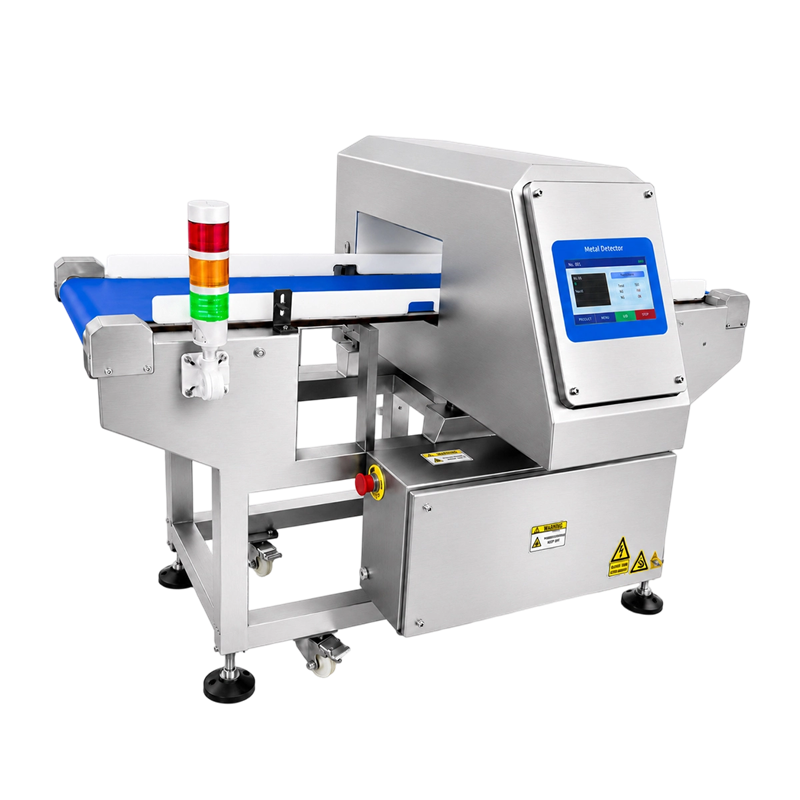
Frozen foods move through a demanding production environment where low temperatures, condensation, ice crystals, dense ingredients, and rapid handling can complicate contamination control. Meat portions, seafood, frozen vegetables, prepared meals, and coated products may also vary considerably in shape and composition, making inspection conditions less predictable than they appear.
In high-throughput manufacturing, a food metal detector provides a crucial checkpoint for metallic contaminants. Foodman Vision stresses consistent product handling, equipment condition, and measurable inspection practices—not just visual checks.
Why Frozen Products Present Distinct Inspection Conditions
Temperature has a direct influence on the physical condition of frozen food. Ice formation can change surface characteristics, while partially frozen products may behave differently from goods held at stable sub-zero temperatures. Moisture migration is another consideration, particularly around transitions between preparation, freezing, storage, and packing.
Product density also varies widely. Frozen seafood, minced meat, vegetables, dumplings, fries, and ready meals may have very different structures even when they pass through the same production area. Dense portions can occupy more of the inspection opening, while irregular pieces may create inconsistent spacing on the conveyor.
Packaging introduces further variables. Film, trays, cartons, and multilayer materials can affect product presentation without themselves being metallic contaminants. Frozen goods may also accumulate frost or surface moisture, so inspection conditions should reflect the actual state in which products reach the checkpoint.
How Production Conditions Affect Detection
Mechanical movement remains an important consideration in frozen-food facilities. Cutting blades, grinders, conveyors, sealing equipment, and other components can experience wear during continuous operation. Small fragments generated by mechanical damage may subsequently travel with the product unless the affected area is identified quickly.
Inspection performance can also depend on operating consistency. Changes in belt speed, product orientation, spacing, or batch composition may alter the conditions under which contaminants are detected. Validation therefore has greater practical value when it represents real production rather than relying solely on laboratory conditions.
Electronic sampling capability is another specification worth examining. The FMD-3015 is listed with a High-Speed A/D Sampling Module, while its product preset specification includes IP54/IP65. These details provide useful reference points when frozen-food processors assess equipment against environmental conditions and production requirements.
Managing Moisture, Frost, and Hygiene
Condensation deserves particular attention during temperature transitions. Frozen products may move between cold rooms and processing areas, creating opportunities for moisture to accumulate around equipment surfaces. Such conditions make enclosure protection and appropriate cleaning practices relevant to day-to-day operation.
Frost can influence product movement as well. Excess accumulation may affect belt tracking, spacing, or the physical presentation of goods at the inspection point. Regular sanitation and housekeeping procedures should therefore consider both food residues and environmental moisture.
Cleaning frequency should match the production environment and equipment design. Frozen-food lines often handle sauces, oils, crumbs, meat residues, or vegetable particles depending on the product category. Inspection equipment needs to remain accessible for routine care without disrupting production unnecessarily.
Matching Inspection With Frozen Food Formats
Product dimensions can differ dramatically across frozen categories. Individually quick-frozen vegetables may pass as loose pieces, whereas frozen pizzas, boxed meals, seafood blocks, and meat portions occupy substantially larger areas. Conveyor configuration should accommodate these differences without creating unnecessary handling problems.
Batch variation also matters. One production run may contain relatively dry frozen vegetables, while another involves moisture-rich seafood or prepared foods with sauces. Such differences make product-specific validation useful, particularly where several recipes share one processing route.
Packaging should be assessed alongside the product itself. Sealed pouches, trays, and cartons can change the distance between the contaminant and the detector opening. Consistent placement helps maintain comparable inspection conditions across repeated production cycles.
Verification Practices for Frozen Food Lines
Routine testing provides evidence that inspection performance remains stable during normal production. Test pieces representing relevant contaminant categories can be introduced according to documented procedures, with results recorded against the applicable product and operating conditions.
Verification intervals may depend on production volume, risk assessment, equipment configuration, and internal quality procedures. Results should be reviewed rather than simply archived, since repeated failures or unusual variations may point toward mechanical, operational, or maintenance issues.
Production changes deserve another review point. New recipes, different package sizes, altered conveyor speeds, or significant equipment adjustments can change inspection conditions. Revalidation following such changes helps maintain a consistent basis for evaluating performance.
Turning Inspection Into Practical Food-Safety Control
Frozen-food inspection works best when it connects with the rest of the manufacturing process. Supplier controls, ingredient checks, preventive maintenance, sanitation records, and traceability procedures each address different parts of the contamination pathway. Metal detection serves as one checkpoint within that broader framework.
Clear documentation can also improve incident investigation. If a contaminant is detected, production records may help identify the relevant batch, processing stage, equipment area, and operating conditions. This information supports a more focused investigation than an isolated inspection result could provide.
Rather than treating frozen-food inspection as a single equipment decision, manufacturers can assess the interaction among product composition, temperature, packaging, conveyor conditions, sanitation, and verification practices. Such an approach gives quality teams more useful information for managing physical contamination risks across different frozen product categories.
Frozen food demands inspection practices that account for its changing physical state as well as the realities of industrial production. With Foodman Vision placed within a broader quality-control framework, food metal detector inspection can become a measurable checkpoint supported by product-specific validation, environmental considerations, and routine verification. Properly matched parameters and documented checks allow manufacturers to respond to contamination risks with greater clarity while keeping inspection aligned with the characteristics of each frozen-food line.
Foodman Vision also provides OEM and ODM support tailored to frozen-food applications. Customization can focus on low-temperature electronics, condensation-resistant enclosures, and conveyor configurations for irregular frozen products. For B2B clients, this includes on-site application reviews and validation support under actual freezer conditions, helping the system stay reliable as product lines and seasonal demands change.
