
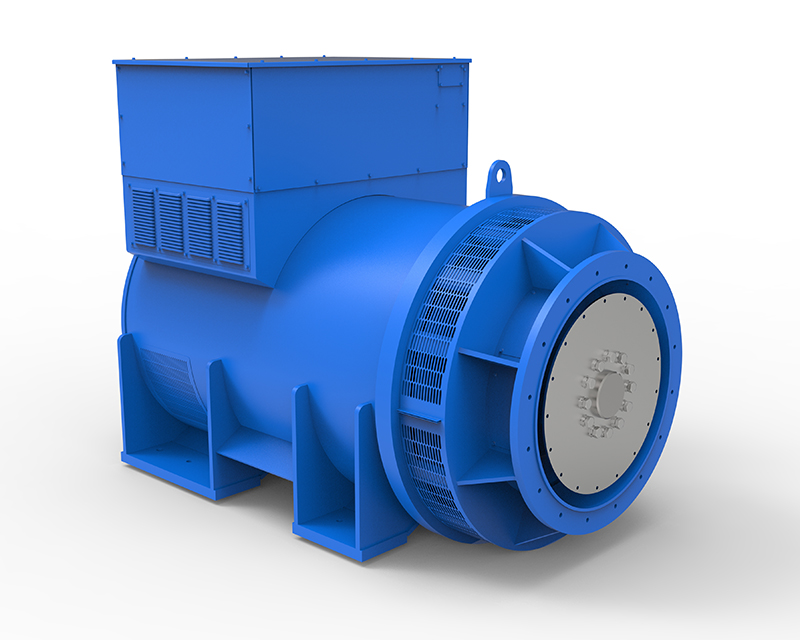
A live busbar places several demands on an incoming alternator before its breaker can close. Voltage, frequency and phase alignment govern that connection, while the drive and protection systems must withstand the forces associated with operation and faults. Fault forces and sustained winding heat make protection and cooling integral to megawatt-scale integration.
A 3000 kVA generator specification therefore needs an operating point and an integration plan. The same distinction matters when a project describes a 3 MW generator: apparent power and active power are different quantities. Following those requirements through the voltage platform, mechanical arrangement and parallel controls produces a configuration that can be assessed as a complete system.
Establish the Electrical Operating Point
Apparent power in kVA and active power in kW belong in separate specification fields. The load’s power factor and intended duty define the alternator’s declared operating basis. A 3 MW generator requirement cannot be substituted directly for the apparent-power rating without establishing the load’s power factor and the applicable operating limits.
Frequency and shaft speed also belong in the specification. The selected variant’s nameplate and data sheet establish the rated voltage, frequency, speed, and continuous output. Matching an alternator to a 3000 kVA generator application also requires checking its temperature rise specification, operating duty, and mechanical compatibility with the prime mover.
Phase count, expected reactive demand and ambient conditions complete that operating point. Sustained station duty places different thermal demands on the package from brief emergency operation. Recording those conditions first prevents a later voltage or cooling change from silently altering the basis of the rating.
Separate Low-Voltage and High-Voltage Platforms
Two EVO568 platforms in EvoTec Power‘s portfolio illustrate how a voltage decision changes the available configuration. The low-voltage industrial family lists 400/480 V arrangements, Class H insulation, a two-thirds winding pitch and ETC-2 regulation. Its stated continuous range begins at 3,000 kVA at 50 Hz, but at 3,600 kVA at 60 Hz.
The separate high-voltage family lists a 3,300–15,000 V envelope, five-sixths winding pitch and PMG excitation. Its published 50 Hz range includes a 3000 kVA generator requirement. These are distinct platforms; their winding, excitation and protection details cannot be combined into a single assumed specification.
For a 3 MW generator installation, distribution voltage also affects switchgear, cables and protection interfaces. At a given apparent power, higher three-phase voltage means lower line current. The project architecture determines whether that tradeoff justifies the different insulation, terminal and equipment requirements.
Check Fault, Cooling and Drive Interfaces
Fault current creates heat in the windings and mechanical forces within the machine. Short-circuit matching for a 3000 kVA generator therefore requires both electrical protection coordination and evidence of mechanical withstand. Fault-current curves and permissible clearing times connect the alternator’s behavior to the selected breakers; a continuous rating cannot replace those checks.
Class H or F identifies an insulation system’s thermal classification. Permitted temperature rise remains a separate operating condition. Cooling for a 3 MW generator must remove the losses at the specified ambient temperature. An air-to-water arrangement, where the installation requires one, adds water-temperature, flow and heat-exchanger interfaces that need confirmation for the proposed machine.
Bearing arrangement, shaft alignment and coupling geometry govern mechanical integration. The high-voltage EVO568 options include a connecting flange ring for a double-bearing arrangement, alongside measuring and differential-protection transformers. The flange defines the mechanical interface; measuring transformers support current measurement, while differential-protection transformers supply signals to the differential protection scheme.
The exciter rotor feeds the main rotor through a three-phase full-wave bridge rectifier. The listed surge suppressor protects that rectifier against disturbances associated with short circuits or loss of synchronism. Its role is local protection of excitation components, while the switchgear still determines how a system fault is cleared.
Coordinate Excitation with Parallel Operation
Reactive load sharing depends on excitation control, whereas active-power sharing depends on the engine controls. A 3000 kVA generator entering a parallel bus needs compatible voltage references and a coordinated sharing method. Incorrect settings can produce circulating reactive current even when the connected machines appear to have similar output ratings.
PMG independently supplies ETC-3; EvoTec Power’s ETC-2 supports parallel excitation control within its over-excitation protection limits. Its general steady-state regulation figure of ±0.5% applies with speed variation within ±4%. That figure describes voltage regulation under stated conditions; it does not specify reactive-sharing accuracy across a 3 MW generator installation or replace synchronizing controls.
Steady regulation and coordinated sharing are separate acceptance tasks. A resistive load test reveals active-power behavior but does not exercise the reactive-sharing requirement. The parallel test plan needs load conditions, agreed control settings and checks of the measurement-transformer connections, rather than relying on an individual regulator’s published accuracy.
Prove the Selected Combination at Commissioning
Commissioning brings the matching work onto the actual bus and drive. For a 3000 kVA generator, the agreed checks cover the operating point, thermal limits, coupling, protection and parallel response. Any 3 MW generator designation retains its separate active-power basis. Factory data and site tests then address different parts of acceptance. The commissioned machine must retain the voltage, frequency and excitation combination approved for the installation.
