
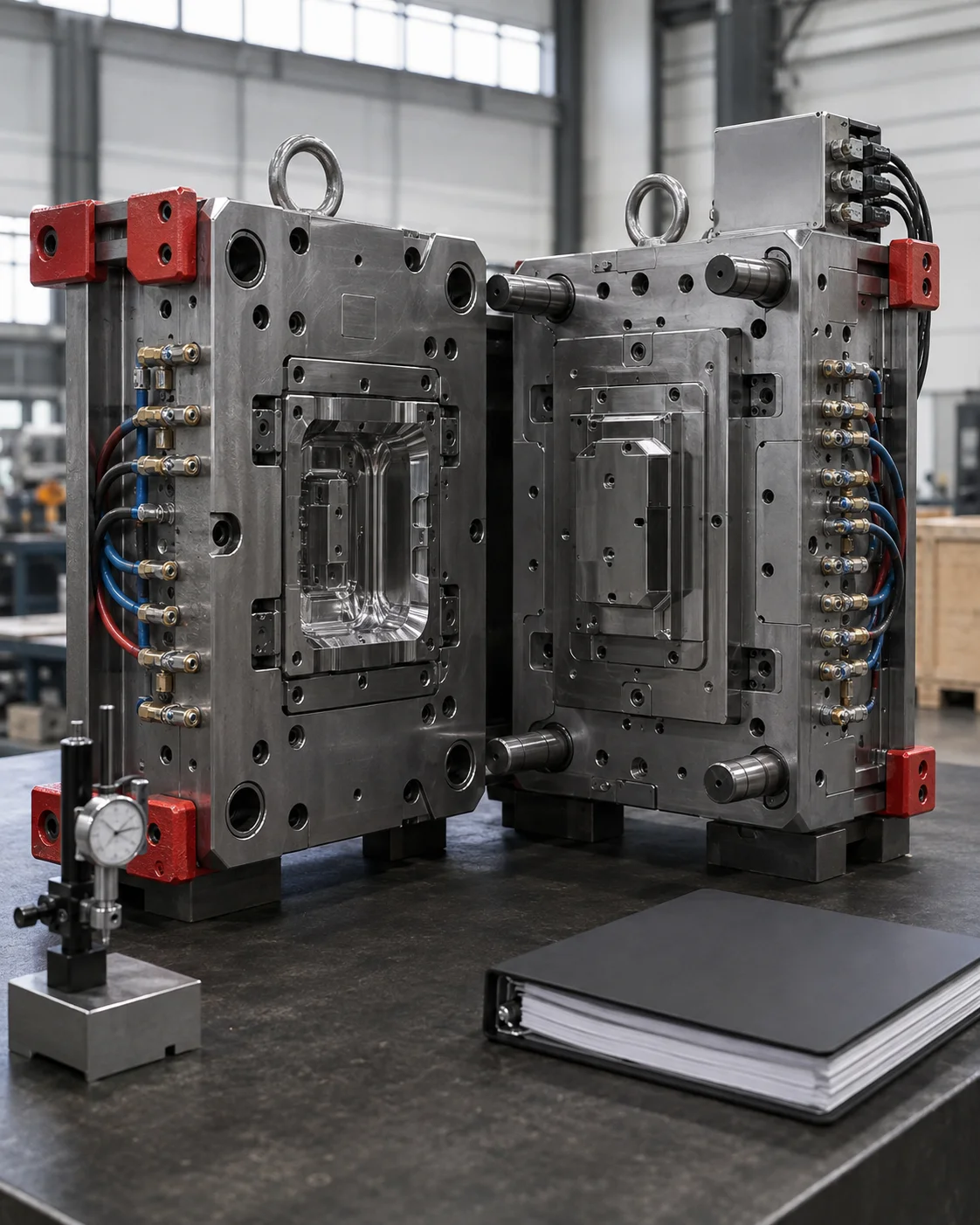
For companies developing a new physical product, the path from CAD design to market launch often depends on how quickly tooling, sampling, testing, and production can move together. A delay in mold fabrication can push back functional testing, certification, pilot production, and even the final launch schedule.
This is where rapid tooling in China can provide a practical manufacturing route. With established capabilities in mold making, CNC machining, injection molding, T1 sampling, and international shipment, a capable Chinese tooling partner can connect several critical stages within one workflow.
For global product teams, the value is not simply a lower tooling price. It is the ability to move from design approval to production-ready samples with fewer disconnected manufacturing steps.
From CAD Files to T1 Samples Without Unnecessary Gaps
Traditional tooling projects can involve several handoffs between design engineers, mold makers, injection molding suppliers, and inspection teams. Every additional handoff creates opportunities for communication errors or schedule delays.
Rapid tooling reduces this friction by integrating engineering review, mold design, machining, assembly, injection molding, and validation into a coordinated process.
At HordRT, the process begins with project review covering CAD geometry, resin, expected volume, tolerances, and required mold life. DFM analysis follows to identify potential manufacturing risks before tool production starts. The tooling is then manufactured through processes such as CNC machining, EDM, wire cutting, and precision finishing before fitting, assembly, and mold trials.
The process culminates in T1 sampling, where molded parts can be inspected for dimensions, appearance, and functional performance. This gives engineering teams physical parts to evaluate before committing to larger production volumes.
Why T1 Sampling Matters for Global Launches
A digital model can confirm design intent, but a molded part reveals issues that may not be obvious on a screen. Assembly interference, draft problems, cosmetic defects, shrinkage, warpage, and material behavior can become visible only after the first mold trial.
Rapid tooling in China can shorten this feedback loop.
HordRT states that its typical rapid tooling lead time is approximately 5 to 10 working days after mold design and DFM details are approved, although the actual schedule depends on factors such as geometry, tooling material, surface finish, and inspection requirements.
For a product team working toward a fixed launch window, receiving T1 samples during the validation stage gives engineering teams an opportunity to make tooling or design adjustments before production.
Flexible Tooling for Different Product Stages
Not every project needs the same mold strategy. A product still undergoing design changes has different requirements from a product preparing for long-term production.
This is one area where rapid tooling in China can support a staged development approach.
HordRT offers prototype tooling for design verification, bridge tooling for pilot runs and early market demand, production tooling for repeat manufacturing, and export tooling prepared for transfer to a nominated overseas molding facility.
Its shared mold base system is another option for projects where tooling investment needs to remain controlled. Customer-specific cavity and core inserts can be manufactured and fitted into a suitable shared mold base, while production-grade injection molding can be used to create functional parts.
This approach allows tooling decisions to follow the product’s development stage rather than forcing every project directly into a long-term production mold.
Production Materials Make Validation More Meaningful
Prototype validation becomes more useful when the samples represent the material and manufacturing process intended for production.
HordRT supports production-grade thermoplastics including ABS, PC, PC/ABS, PP, POM, PA, PMMA, PBT, TPE, TPU, and PPS. Its tooling materials include aluminum, P20, NAK80, S136, H13, and other project-specific steels.
Using appropriate production materials allows teams to evaluate fit, function, appearance, assembly, and other product characteristics under conditions closer to actual manufacturing.
For products requiring overmolding, insert molding, undercuts, slides, or lifters, tooling can also be configured around the actual part geometry and production requirements.
China Manufacturing With Export Coordination
A successful global launch does not end when the mold is completed. Tooling, molded samples, documentation, inspection, and shipment must also fit the customer’s broader manufacturing plan.
HordRT operates manufacturing facilities in Guangdong, China, with its Zhuhai facility focused on plastic and tooling and its Zhongshan facility supporting metal manufacturing. The company reports more than 1,800 mold sets of annual tooling capacity, more than 100 precision machines and tooling equipment, and customers across more than 20 countries.
Its export tooling service is designed for customers who eventually need to transfer tooling to a nominated molding facility overseas. Documentation and secure shipment are incorporated into the transfer process, helping connect Chinese toolmaking with a wider international production strategy.
HordRT Connects Tooling With the Next Manufacturing Step
The strongest advantage of a rapid tooling supplier is not simply producing a mold quickly. It is understanding what happens after the mold is finished.
HordRT manages DFM, toolmaking, mold trials, inspection, and injection molding within one coordinated manufacturing workflow. Its quality process includes material verification, dimensional inspection during machining, T1 sample validation, and final tooling review. CMM inspection and 3D blue-light scanning are available according to project requirements.
For global product development, this integrated structure can reduce communication gaps between tooling and molding teams while making design feedback easier to incorporate.
Moving From Product Development to Market With Greater Control
Rapid tooling in China is increasingly relevant to companies that need to balance development speed, tooling investment, product validation, and future manufacturing plans.
The right manufacturing partner can provide more than a mold. It can connect DFM analysis with toolmaking, T1 sampling with inspection, and prototype validation with bridge or production manufacturing.
With its engineering-led DFM process, in-house toolmaking, shared and dedicated tooling options, production-grade injection molding, inspection capabilities, and export tooling support, HordRT provides an integrated route from CAD files to validated molded parts and subsequent production.
For product teams working against demanding launch schedules, that connection can make the manufacturing process easier to coordinate and create a clearer path from the first tool trial to global market delivery.
